Click on different parts of the castle to explore…
![]()
For nearly 600 years the Mill and Engine House used the power of the River Avon to grind grain. A century ago that same 'hydro' power was harnessed by the Castle's engine house to generate electricity for the household.
Now the Mill and Engine House has been carefully restored so you can see how electricity arrived at the Castle in 1900 and how the Castle shot to the forefront of Victorian technology.
Discover how the development of electricity excited the Castle and changed the life of those above and below stairs.
The Earl and Countess of Warwick were great innovators of their time and wanted the prestige and luxury that the installation of generating equipment would bring. In 1894 the generating plant was installed in the Mill and Engine House and the Castle was wired up.
In December 1894 the work was completed and 475 bulbs were lit to the delight of Countess Daisy as it coincided with her birthday. By modern standards the lights would not have been very bright but those who saw them thought them wonderful!
In the Mill and Engine House you can also find out about the responsibility of the Mill Engineer and how day after day, year after year he tended the generating system and kept it running. See into the Mill Engineer's office and discover how the generating system was maintained to ensure the supply of electricity to the Castle was constant.
So much of the original generating system has been successfully repaired and replaced that the Mill and Engine House can now generate enough electricity to keep the attraction running.
![]()
Downstream from the mill, a bridge takes you across the Avon and onto the island.
In the 1890s, the island used to be inhabited by, amongst others, some Japanese deer, a flock of Chinese geese, an emu, assorted racoons, an ant bear and a baby elephant.
They were part of a menagerie collected by the Countess of Warwick. The elephant got rather big, as elephants do, and had to be given to an animal trainer in Leamington Spa. The emu, on the other hand, entered the pages of emu history by chasing a bishop through the castle grounds.
The popular activity of pleasure boating saw much innovation at Warwick Castle when the Earl and Countess purchased an electric launch. Delivered to the castle by the Great Western Railway company in 1898, the luxurious launch had comfortable fittings, such as carpets, blinds and awnings and was powered by a number of batteries which were re-charged in the millhouse.
![]()
The beautifully proportioned conservatory, which acts as a focal point in the landscape, was built in 1786 by a local mason, William Eborall.
Originally, it was designed as a home for the Warwick Vase, a magnificent piece of ancient Roman pottery excavated near Tivoli in 1771.
The original vase is now on display at the Burrell Collection in Glasgow. There is, however, a full-size replica standing in the conservatory, which has since been converted back to its Victorian use as an ornamental glasshouse for growing exotic plants.
Directly in front of the conservatory is the Peacock Garden, designed by the Victorian landscape gardener Robert Marnock.
Running gently down to the river is Pageant Field, flanked on either side by trees, of which some, like the Cedars of Lebanon, are over 200 years old.
![]()
First laid down in 1868, the Rose Garden, like the Peacock Garden was designed by Robert Marnock.
By the end of the Second World War, though, it had disappeared under a tennis court. Fortunately, two of Marnock's original drawings survived, so the plot was lovingly brought back to life in 1986.
Its charm stems from the contrast between the very precise geometry and proportions of the beds and the garden's informal, almost secretive setting.
The roses are all of the old-fashioned type, many of them popular with the Victorians. To commemorate the recreation of the garden, 120 years on, a new English rose was bred and named 'Warwick Castle'. The best time to see the display is in late June and the whole of July.
The pair of unusual icehouses date back to the 1830s and were built in the earth bank facing away from the sun. They were still being used in 1869 when in December of that year 16s 4d allowance was paid 'to men filling the ice houses'.

![]()
Towers were the mainstay of a castle’s defensive system. Because they projected above and out from the wall, they gave archers a clear view downwards and sideways.
Guy’s Tower was built in the 14th century. It is twelve-sided, stands 39 metres high and has five storeys.
The first four storeys consist of a central stone-vaulted chamber with two small side rooms – one a gardrobe (toilet), the other probably a bedchamber.
The fifth storey is a hexagonal guardroom. During the Civil War the windows here were enlarged so that they could take small hand-held cannons.
![]()
The walkways that run along the curtain walls meant that crossbowmen and archers could move swiftly to quell danger at any point on the perimeter.
Once in position they could pick off the enemy from the battlements. These consist of solid sections of wall, called merlons, and gaps, known as embrasures.
The tops of the towers are encircled by parapets that added a further layer to the castle's defences.
Cut into the floor of the parapet at regular intervals are openings, or machicolations, through which the garrison could drop stones or pour boiling pitch and quicklime onto the unfortunate attackers below.
On the wall to the right Clarence Tower is a rare corbelled turret or crow's nest. A watch would be posted there to keep a lookout along the base of the curtain wall.
![]()
Set in the centre of the north wall, these two stunted towers are all that is left of the mighty Tower House which Richard of Gloucester (future King Richard III) started to build in 1478.
It was to have been the same height as Guy's Tower, but twice as wide, with a turret at each of its four corners.
However, this gigantic Royal Keep was intended not just to repel an attack from beyond the walls. It was also designed to protect against a mutinous attack from within the castle itself.
At ground level wells were dug and baking ovens installed, providing the domestic means necessary for those safe inside to endure an attack. In the walls, arrow loops and holes drilled to take cannon are features of the structure's defensive measures.
In 1485 Richard was killed at Bosworth and the building stopped. The Clarence Tower is named after Richard's elder brother, the Duke of Clarence. It is thought that the other tower housed bears that were used for baiting.

![]()
First built in 1068 on the orders of William the Conqueror, it formed the most important part of the Norman castle's defence system.
Advances in military architecture, however, made it more and more of an outpost. By the 17th century, it had been absorbed within Sir Fulke Greville's garden, topped by a single Scots pine.
Today, it is the perfect vantage point, not for defending against marauding English troops but for taking in the beautiful unfolding views of these peaceful grounds.
![]()
First built in the 14th century to guard against enemy approaches from the river, the interior décor reflects the later Jacobean style.
A prominent Elizabethan and Jacobean courtier (his poetry, published posthumously in 1633, won him a reputation also as an important writer), Sir Fulke Greville had been keen in the early years of his political career to see military action abroad. His enthusiasm for the venture, however, was repeatedly thwarted by Queen Elizabeth's insistence that he stay in England.
Greville spent a sizeable part of his income (in 1619 it was a colossal £7000 per year) turning the semi-derelict castle into a stately residence. Work was sufficiently advanced for James I to be received in 1617 and for Bishop Corbett, a friend who visited in 1618, to remark of the refurbished castle that "it seems nor art nor force can intercept it. As if lover built, a soldier kept it".
However generous his spending plans for the castle, it was, tragically, an accusation of meanness that led to his death in 1628. While in London, an argument broke out between Greville and one of his servants, Ralph Haywood, over the contents of Greville's will. Haywood, convinced that his master had not bequeathed him his rightful due, drew a knife and stabbed Greville – the Earl died 27 days later. Realising the enormity of his actions, Haywood fatally turned the blade on himself.
Greville had once expressed a wish to have tombs built for himself and his friend and fellow poet, Sir Philip Sidney, in St Paul's Cathedral. In the end it was to the Church of St Mary in Warwick, that Greville's body was taken and laid to rest in the tomb he had prepared for himself there. It is said, however, that his ghost still haunts this tower in which he lodged.
![]()
The Great Hall is the largest room in the castle and throughout history has been its heart.
In the early middle ages, straw and dirt covered the floor of the Great Hall. Burning in the centre of the room would have been a large fire, its smoke turning the air acrid. The only natural light filtered through narrow lancet windows. Here it was that the nobility ate, drank and even slept.
The Hall as it stands today, was first constructed in the 14th century. It was rebuilt in the 17th century and then restored in 1871 after it had been badly damaged by a fire which swept through part of the castle.
Set against the wall is the magnificent Kenilworth buffet, made in oak by local craftsmen for the Great Exhibition of 1851. In the window is a huge cauldron known as 'Guy's Porridge Pot', named after the 10th Earl of Warwick. About 500 years old, it was used to cook stew for the castle's garrison of soldiers.
Chapel
Sir Fulke Greville, the first Lord Brooke, authorised the building of the small chapel in the early 1600s. It may be on the site of another chapel founded as long ago as 1119.
State Rooms
Retaining portions of the mediaeval Castle of the 14th Century, the State Rooms have been extended, altered and embellished during virtually every century since to lavishly entertain the noblest of guests, and to display the family's most prestigious possessions.
![]()
In 1898, Daisy, Countess of Warwick hosted a weekend party at which the principle guest was the Prince of Wales, later Edward VII.
Once inside the former private apartments, you'll step back to a time of the most lavish and extravagant parties at Warwick Castle. Meet the beautiful Daisy, Countess of Warwick and her friends preparing for their weekend party.
The Royal Weekend Party brings to life the secrets of a Victorian household and all its important guests. Encounter a young Winston Churchill and listen to Clara Butt, renowned singer of the time and Paolo Tosti, music master to the Royal Family.
Most of the furnishings and fittings are those that were actually here in 1898, and photographs taken at the time mean that it has been possible to put every chair, table, bed and book in exactly the place it occupied exactly 100 years ago. Daisy's exquisite evening gown and the lavish decoration of her bedroom were recreated from photographs of Daisy's ancestral home, Easton Lodge. It was clear that no expense was spared in her luxurious lifestyle.
![]()
The Kingmaker attraction recreates the mid fifteenth century world of Richard Neville, Earl of Warwick, Kingmaker.
The Wars of the Roses, which began in the early 1450s and ended with the battle of Bosworth in 1485, were a prolonged struggle for supremacy between the Houses of York and Lancaster. During this time, Richard Neville, Earl of Warwick from 1449 - 1471 became known as 'The Kingmaker'. Neville's family connections made him a Yorkist. He held a command at the battle of St Albans in 1455 that brought about the defeat of the Lancastrians and the capture of Henry VI. By 1461, the Yorkists had won the first war of succession and the son of the Duke of York became King Edward IV.
Neville's power began to wane when King Edward married Elizabeth Woodville. Plotting with Edward's brother, the Duke of Clarence, he raised an army in 1469 and took the king prisoner, holding him at Warwick Castle. Trying to rule through a captive king proved futile, and Warwick fled to France, pledging his allegiance to the exiled wife of Henry VI. He then returned to England, overthrew Edward, and restored Henry to the throne. Warwick was killed at the battle of Barnet in 1471.
In the days before Warwick's army moved south in that spring of 1471, the Castle would have been a hive of activity. Troops had to be summoned and levied, weapons cleaned and provisions collected.
In 'Kingmaker - a preparation for battle' you can see how a mediaeval household prepared for Richard Neville's final battle - find out how weapons were made, how the army was clothed and what mediaeval life was really like through sights, sounds and even smells!

![]()
Built on the orders of Thomas de Beauchamp, Caesar's tower is a masterpiece of 14th century military architecture.
It has an irregular quatrefoil or cloverleaf shape and rises 44.8 metres from the solid rock just above the river level. Not including the dungeon, it has three storeys. These are topped by a platform with a crenellated and machicolated parapet.
Behind the parapet there is another storey again which contains a hexagonal guardhouse.
![]()
Experience the drama, noise and adrenaline-charged terror of mediaeval battle through the dreams of William, a 12 year old squire, as he sleeps the night before setting off to fight for the Earl of Warwick in the most decisive battle of the Castle’s history.
The experience is a nightmare journey through some of the oldest areas of the ancient fortress. Telling the story of the Castle’s most fateful conflict through the eyes of 12 year old William, audio visual effects and a powerful film blending live action and computer generated imagery, bring to life the young squire’s dreams as he prepares to bear arms for the first time at the Battle of Barnet.
Become immersed in William’s ‘Dream of battle’ as it descends into a nightmare. Would you sleep soundly the night before going to battle?
Children under 8 must be accompanied by an adult
![]()
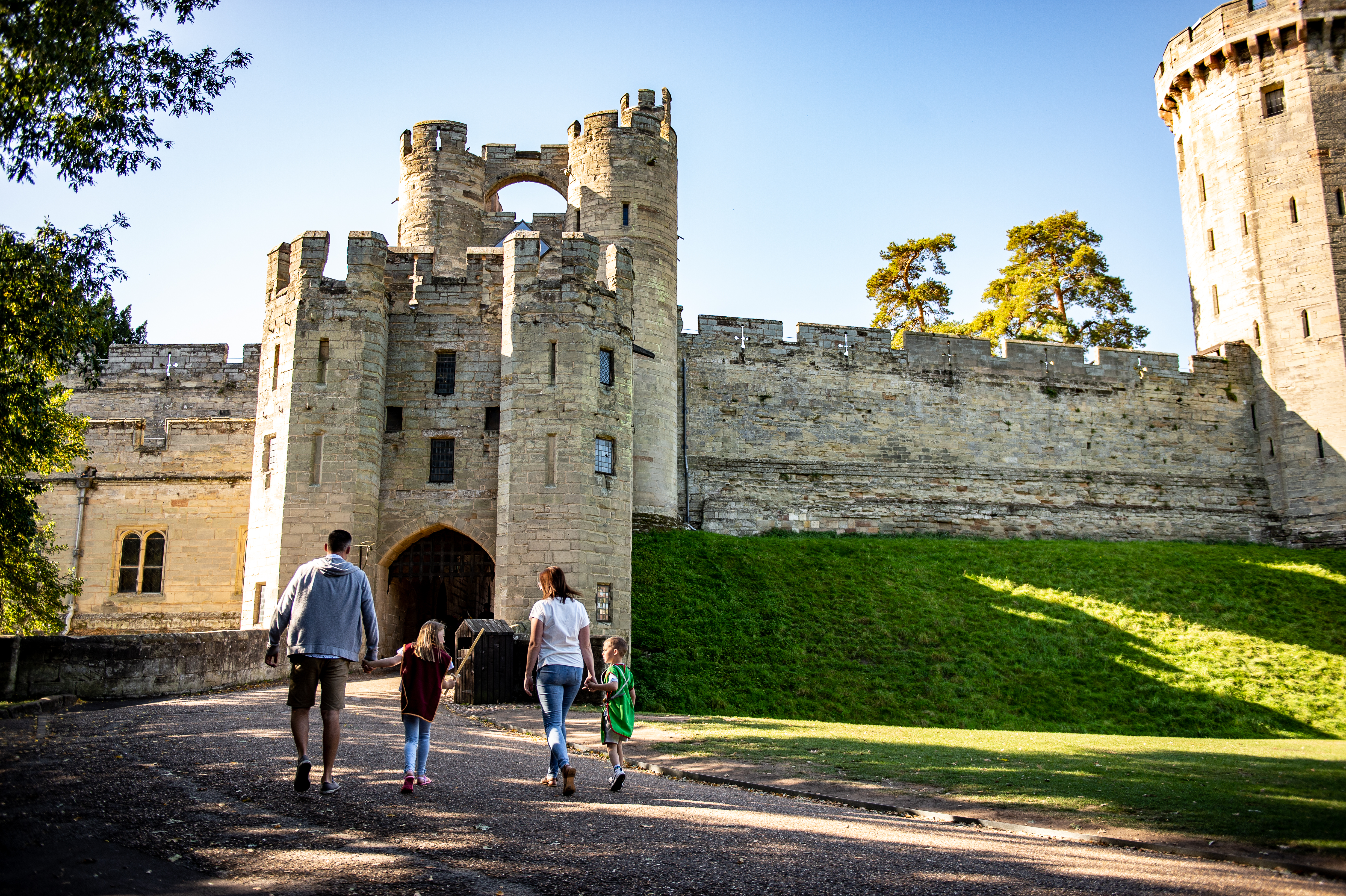
Since the entrance to the castle was likely to be a favourite target for an attacking force, it was vital to fortify it as heavily as possible. The barbican, which had a drawbridge, reaches out into the dry ditch to give the gatehouse more protection.
Soldiers would be faced with the first iron portcullis and a barrage of crossbow bolts. If somehow the barbican portcullis failed to lower, the attackers would find themselves in a narrow roofed passage with arrow slits to either side and, worse, murder holes in the ceiling from which stones and missiles would rain down on them. Colossal wooden doors further prevented them.
Those who survived would then have to struggle through raking crossfire up towards the gatehouse itself. Here they would be confronted by yet another portcullis, another set of murder holes and another door...
![]()
Occupying the lowest chamber of Caesar's Tower and built in the 14th century is the Dungeon. Leading from a hatch in the ground at the base of the tower, a single narrow flight of steps provided the way into, and the only way out of, the castle's miserable dungeon. Beyond a locked door at the foot of the steps, prisoners would endure days, weeks and months, in the small dark space. A single open drain running across the floor provided the only means of sanitation.
Whilst the only light to penetrate the gloom came from a tiny shaft high on the wall, and a small window in a chamber, safely behind an iron grill, from where a guard could observe the wretched prisoners. One such prisoner, a Royalist held captive during the Civil War, left a message that is still visible today...
